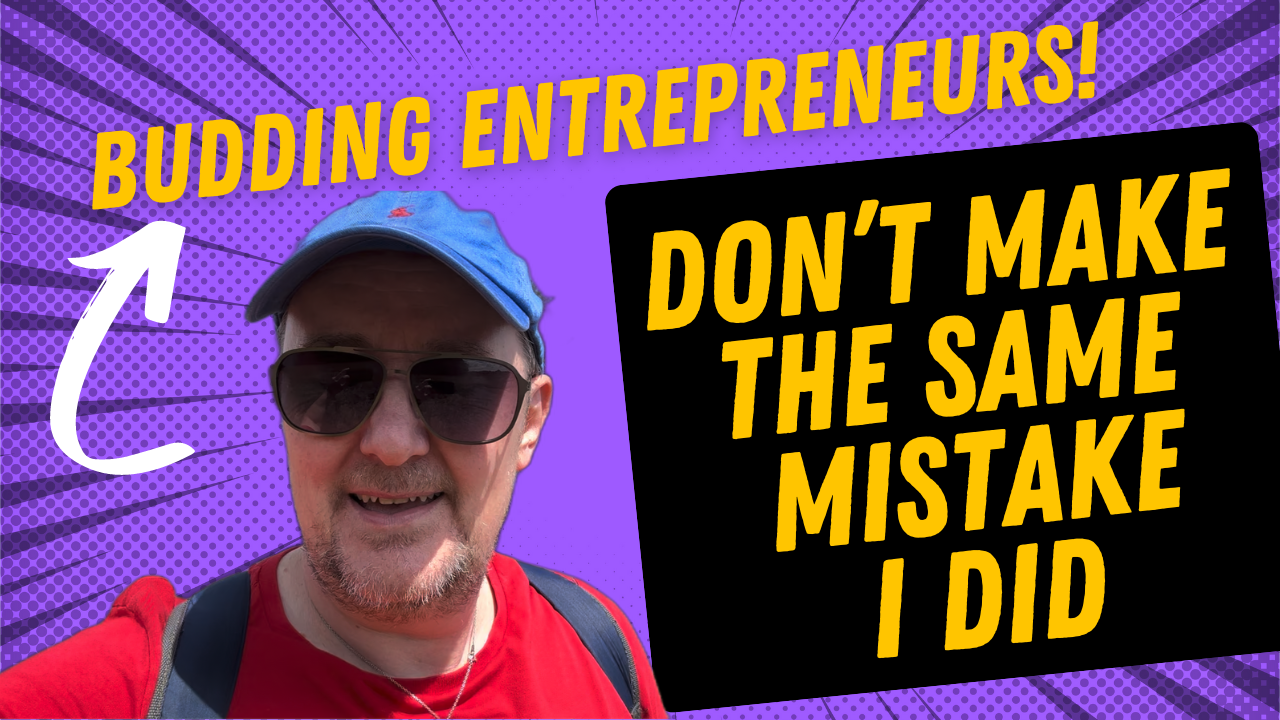
Budding Entrepreneurs: Don't make this mistake like I did!

grant • July 28, 2024

Share this article

I vividly remember it—22 or 23 years ago. It feels like just yesterday when I decided to take the leap and start my own business. At the time, I had a full-time job, and it was a great one. I had some really cool coworkers, a great company car (loved that car), and a decent salary. Everything seemed perfect on the surface. I was in my late twenties, and despite these perks, I had this burning desire to set up my own business, a dream I'd harboured for years. Yet, every attempt felt like a false start. Something always held me back.
Some people call it "golden handcuffs," others "corporate apathy." For me, it was this invisible barrier, a paralysing fear of the unknown. I found it incredibly difficult to pull the trigger. But eventually, I did. At the age of nearly 29, I finally took the plunge. I remortgaged my house, handed in the keys to my beloved company car, rented an office, and bought the necessary equipment. It felt like a monumental step, but it was just the first of many.
One of the biggest obstacles was the belief that successful entrepreneurs possessed some elusive, special skills—traits I thought I lacked. The people I admired, including my bosses, seemed to have a certain aura, an untouchable genius. However, I soon realised that success in business doesn't require superpowers. You don't need to be exceptionally intelligent or extraordinarily creative. What you do need is focus, dedication, speed, discipline, and an unyielding commitment to never give up.
These qualities, which I had to develop rapidly, were the true keys to success. The most crucial lesson I learned early on was that I was more than capable of running a business. I could get clients, complete tasks, and grow my enterprise. This newfound confidence fuelled my journey. And so, over the years, I've started numerous businesses across various sectors, experiencing both success and failure, collaborating with partners, and going solo.
Throughout this journey, I've helped over 300 people start their own businesses. A recurring theme I've observed is the paralysing effect of corporate apathy. Many aspiring entrepreneurs, much like I was, are stuck in well-paying jobs that leave them dissatisfied. They dream of being their own boss but are held back by the comfort and security of their current roles.
Corporate apathy causes endless planning and delays. People take months, sometimes years, to pull the trigger, often realising too late that they should have acted sooner. If you have that entrepreneurial itch, the first step is to take action. While planning is essential, it's crucial not to get trapped in perpetual preparation. The corporate world teaches us to delay, another meeting next week, another few weeks to think things over. As entrepreneurs, we must break free from this mindset.
When you join the Blam Partnership program, for instance, the information needed to make a decision is readily available. Yet, many spend weeks, months, or even years contemplating. The fear of the unknown is a significant psychological hurdle, but overcoming it is vital. Once you do, you can continuously take swift, decisive actions. This is the hallmark of successful entrepreneurs: 
Money loves speed.
Remember this, money really does love speed and perfection I the enemy of speed. In the entrepreneurial world, a week is often too long to make a decision. The information you need to move forward is usually at your fingertips. Assimilate it, decide, and act. Success favours those who take swift, informed actions.
So, if you're feeling the pull towards entrepreneurship, don't let corporate apathy hold you back. Take control, embrace speed, and make your dreams transform into reality. Then, keep moving forward in your decisions from then on.
To your success,
Grant

Recent Posts

Man using a laptop at a wooden desk in a bright home office, with a chart on screen and shelves behind him
By Jamieson Lee Hill June 4, 2026
AI is reshaping service delivery, margins and client expectations. Discover how Blam Digital's Trust to Transaction Pathway helps agencies scale without fulfilment.
By Jamieson Lee Hill March 5, 2026
Intelligent Call Handling That Converts Missed calls quietly drain revenue from small businesses every day. When Jamieson Lee Hill, founder of Blam Digital, interviewed CRM Developer and AI Automation Specialist Livingstone Kariuki at Blam HQ in Birmingham, the conversation focused on a simple but critical question: how do small businesses stop losing opportunities simply because they cannot answer the phone? Blam’s AI answering service for small businesses has been built to solve that exact problem. Designed in Birmingham, UK, and delivered through a network of 300 partner agencies across 10 countries , the system is engineered to move inbound calls toward meaningful outcomes rather than trapping callers in frustrating loops or dead ends. For businesses searching for a reliable AI phone answering service UK solution with international scalability, the model combines structured automation with human oversight. This is not a replacement for human service. It is a structured, intelligent call progression that protects revenue and improves operational efficiency.
February 24, 2026
Systems-Led Leadership at Blam Digital Grant Stain is the Founder and CEO of Blam Digital, established in 2015. His leadership approach is defined by long-term thinking, structured systems, and a deliberate focus on building agencies that remain stable through market shifts, technology change, and economic cycles. Rather than chasing fast growth or short-term tactics, Grant built Blam Digital as an infrastructure-first business. The intention was clear from the beginning: give agency owners a repeatable framework they can rely on, instead of forcing them to constantly reinvent services, pricing, and delivery. That approach now supports more than 300 partner agencies operating across 10 countries.
February 9, 2026
Serving SMEs, Schools, Councils, Sports Clubs If you run a school, local authority, SME, sports club, or charity, you do not need a clever website. You need a website that produces action. Enquiries, applications, bookings, donations, registrations, or the correct contact route. That is what AI websites that convert are built to deliver.Blam Digital delivers AI websites that convert through a certified partner network. AI is used to improve speed and insight, while human specialists handle strategy, structure, SEO, accessibility, and quality control. This ensures performance improves without increasing risk.
February 2, 2026
How Broken Digital Systems Kill Enquiries If your website is not generating enquiries, you are not imagining it. Many owners and decision-makers sense something is wrong long before they can explain why. The site looks fine. Traffic exists. Marketing activity is happening. But enquiries, orders, or meaningful actions remain weak or inconsistent. This article explains why websites fail to convert visitors into enquiries, what is usually broken underneath, and how organisations fix it without rebuilding everything. Blam Digital works with SMEs and organisations, including schools, sports clubs, charities, and local authorities, and sees the same structural problems repeatedly.
October 27, 2024
One topic that often comes up in my coaching sessions with budding entrepreneurs is imposter syndrome. It’s that feeling of not being “credible” enough or worrying that we might not truly deserve the roles we’ve claimed in our businesses. Often, this isn’t something people willingly share; rather, it’s a subject that usually needs to be coaxed out of them. Imposter syndrome is essentially the fear that we don’t know enough, aren’t authoritative, or simply aren’t “good enough” to do what we say we’re doing. I see this challenge all the time within the Blam Partnership Programme. For many people, joining Blam means diving into a whole new world of digital marketing. They become certified marketers within a few weeks, learning new knowledge and skills at a rapid pace. But because they’re just starting out, they lack the hands-on experience behind that knowledge, and that’s often when the imposter syndrome kicks in. Facing Imposter Syndrome Head-On When new Blam partners step out to meet potential clients, they might feel like they’re on shaky ground. Speaking to established business owners and advising them on their digital marketing is no small feat, especially if you’re just starting your own entrepreneurial journey. But here’s the key insight I always share: the process, the training, and the systems we use at Blam give them knowledge that, while fresh to them, is immensely valuable to the businesses they’re serving. The beauty of the Blam model is that once a Partner makes a sale, they can rely on a whole team of experts to deliver what’s been promised. This support system is there to back them up, and it allows Blam Partners to lean on their new knowledge with confidence, knowing there’s a skilled team to fulfill their commitments. Imposter Syndrome Never Truly Disappears The truth is, imposter syndrome doesn’t just vanish after the initial stages of business. It can resurface at any time, often when you’re about to tackle something new. I know this from experience because I still face it, even after years of building and coaching businesses. In fact, right now, I’m about to launch a YouTube channel to reach even more budding entrepreneurs, providing case studies, interviews, and entrepreneurial advice. And, yes, despite everything, there’s still that nagging question: Why would people want to listen to me? If I’m honest, it took me years to feel comfortable in front of the camera, and even longer to recognise that being the face of a brand can help you connect with the audience you’re aiming to support. Putting yourself out there can be challenging, especially when you’re committed to providing real value. Reframing Imposter Syndrome Imposter syndrome doesn’t mean you lack knowledge or expertise. For my part, when I look back at my journey, I’ve coached hundreds of entrepreneurs, built seven-figure businesses, and, yes, had some failures. But those experiences form the foundation of my expertise, even if I sometimes feel like “little old me” isn’t the obvious choice to give advice. The takeaway is this: If you experience imposter syndrome, you’re in good company. I’d even argue that if we didn’t experience it, we might become arrogant, and that’s certainly not an endearing or effective way to connect with others. Embrace that inner doubt, but don’t let it hold you back. Instead, lean on the facts. Recognise the tools, training, and knowledge at your fingertips. In most instances, if you’re genuine and straightforward with your clients, you’ve got everything you need to deliver. Moving Forward with Confidence If you’re an entrepreneur dealing with imposter syndrome, remember that feeling unsure is part of the journey. Everyone feels it, it’s not a sign that you’re incapable, but rather that you’re pushing yourself to grow. Embrace that vulnerability, lean on the support systems you have in place, and trust in the value you bring to your clients. If you’d like to know more about the Blam Partnership Programme, check out the links below. And keep an eye out for my upcoming podcast, where I’ll dive deeper into topics like this and share more insights for those of you taking your first steps into the entrepreneurial world.
Show More