Do You NEED a digital detox?
August 13, 2023

Unplug and Recharge: Time for a Digital Detox
This story begins with me and my CFO eating lunch talking about the business like we do a couple of times a week. My CFO is a very experienced business owner and has been buying and selling businesses since he was in his 20’s (decades!). He told me that years ago he used to take time out to travel the world, both after selling a business but also during owning a business that was pretty much on auto-pilot. He could tell that I was under pressure at the time (which is unlike me) and advised I take some time out
Time out of the business?
What he meant was a complete switch off from the day to day of managing of a modern business. No phone, laptop, TV or connection to the internet. He was talking about a digital detox. He has some super successful entrepreneur friends that do this regularly and recommended I try it, I may be surprised at the results.
My immediate reaction was “No way, why would I need to do that?” Firstly what if I miss something important, like an urgent message regarding the business! Then I started to do a bit of research and think about what the advantages could be…
The thought of it made me feel very uncomfortable, but I could see some opportunities to learn and grow in doing it.
Here’s what Google thinks a digital detox could accomplish: • Reduce Stress. Tech overload causes anxiety, stress, and generally isn't very good for your mental health. • Increase productivity and creativity. • Recharge your brain. • Improved sleep quality. • Better physical health. • Improve relationships. • Reduce depression and anxiety. • Feel happier.
I had a holiday coming up in the next couple of weeks, so I decided putting myself outside of my comfort zone was an opportunity to undertake some entrepreneurial self-development and then share my results with you guys, fellow entrepreneurial thinkers.
So, a couple of weeks later, I arrived at a beautiful Spa Hotel in Fuerteventura in the Canaries (one of my favourite places in the world), turned my phone onto airplane mode, took off my Apple Watch and put them in a drawer.
What followed was 4.5 days of virtually no tech or connection to the internet (hence you didn’t get my email last week). I say virtually as I did make a small exception and checked my messages on my phone first thing every morning just in case there was something that just couldn’t wait.
So, what happened?
Well, I have to say, it wasn’t what I expected! I actually didn’t feel any anxiety or detox, no feeling of loss or that I was missing something in my pocket. In fact, it was at first more of a mild inconvenience of not being able to communicate with the family whilst on holiday. But with some quick minor adjustments, I was more than comfortable pretty much straight away!
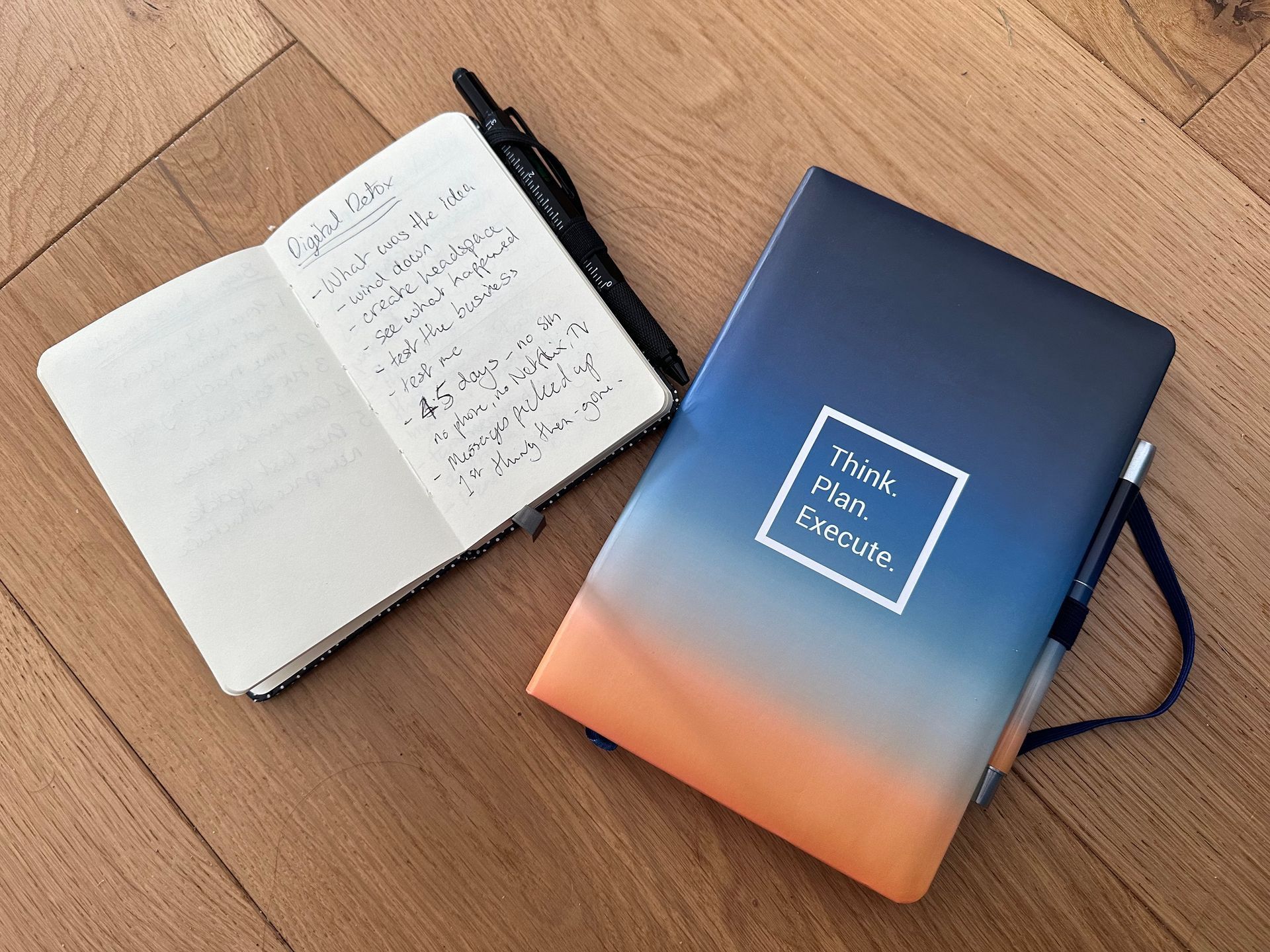
The first thing I did was buy a small pocket notepad, a larger one too, and some pens. I carried them around with me so when the inspiration took hold I could write down my thoughts the old-fashioned way. And it felt great. By the time I hit day two, it felt perfectly normal to not have my phone on me.
Here’s what I missed: • Taking photos with my phone whilst on holiday • Messaging people with me on holiday to co-ordinate where we were meeting etc • Maps for directions • Looking up websites for reference and information
Here’s what I didn’t miss: • Constantly checking notifications • Being tech support • Carrying my laptop round • Unscheduled phone calls
It soon became standard practice to get my family to take photographs, be more communicative about when and where to meet each other and use a paper map if directions were required (there are still loads of these around whilst in a holiday resort). I used my notepads a fair bit, actually read a fictional book and used the gym a lot!
Having been back a couple of days now, I’ve had time to reflect on what I’ve learned and digest what the pros and cons are of doing a digital detox. I actually got a lot out of it but didn’t experience any kind of epiphany, which I’d secretly hoped I might do, lol! I think that as I spent most of my life without a smartphone, going back to not having one wasn’t too much of a chore. If you are in your 20s it may come as more of a shock!
My conclusions are that it’s done me a lot of good in many subtle ways. Mostly it created headspace for me to do some very clear thinking on the direction my business is taking. My notepads are sat with me now and they are key to actioning the five key strategies I want to implement immediately in the business as a result of the clarity I gained.
So do I recommend you give it a go? Definitely, but plan ahead: • Make sure everyone important to you and your business knows what yo are doing. • Set up an autoresponder “I’m on a digital detox” on your email. • If you are doing more than a couple of days make sure it spans the weekend if you are in a business where less happens during that time. • Get a pocket notepad. • Try and do it whilst you are away from your usual environment.
If you give it a go, I’d love to hear if you had a good or bad experience or any extra tips you can provide me with for my next digital detox!
To your success
Grant

Time out of the business?
What he meant was a complete switch off from the day to day of managing of a modern business. No phone, laptop, TV or connection to the internet. He was talking about a digital detox. He has some super successful entrepreneur friends that do this regularly and recommended I try it, I may be surprised at the results.
My immediate reaction was “No way, why would I need to do that?” Firstly what if I miss something important, like an urgent message regarding the business! Then I started to do a bit of research and think about what the advantages could be…
The thought of it made me feel very uncomfortable, but I could see some opportunities to learn and grow in doing it.
Here’s what Google thinks a digital detox could accomplish: • Reduce Stress. Tech overload causes anxiety, stress, and generally isn't very good for your mental health. • Increase productivity and creativity. • Recharge your brain. • Improved sleep quality. • Better physical health. • Improve relationships. • Reduce depression and anxiety. • Feel happier.
I had a holiday coming up in the next couple of weeks, so I decided putting myself outside of my comfort zone was an opportunity to undertake some entrepreneurial self-development and then share my results with you guys, fellow entrepreneurial thinkers.
So, a couple of weeks later, I arrived at a beautiful Spa Hotel in Fuerteventura in the Canaries (one of my favourite places in the world), turned my phone onto airplane mode, took off my Apple Watch and put them in a drawer.
What followed was 4.5 days of virtually no tech or connection to the internet (hence you didn’t get my email last week). I say virtually as I did make a small exception and checked my messages on my phone first thing every morning just in case there was something that just couldn’t wait.
So, what happened?
Well, I have to say, it wasn’t what I expected! I actually didn’t feel any anxiety or detox, no feeling of loss or that I was missing something in my pocket. In fact, it was at first more of a mild inconvenience of not being able to communicate with the family whilst on holiday. But with some quick minor adjustments, I was more than comfortable pretty much straight away!
The first thing I did was buy a small pocket notepad, a larger one too, and some pens. I carried them around with me so when the inspiration took hold I could write down my thoughts the old-fashioned way. And it felt great. By the time I hit day two, it felt perfectly normal to not have my phone on me.
Here’s what I missed: • Taking photos with my phone whilst on holiday • Messaging people with me on holiday to co-ordinate where we were meeting etc • Maps for directions • Looking up websites for reference and information
Here’s what I didn’t miss: • Constantly checking notifications • Being tech support • Carrying my laptop round • Unscheduled phone calls
It soon became standard practice to get my family to take photographs, be more communicative about when and where to meet each other and use a paper map if directions were required (there are still loads of these around whilst in a holiday resort). I used my notepads a fair bit, actually read a fictional book and used the gym a lot!
Having been back a couple of days now, I’ve had time to reflect on what I’ve learned and digest what the pros and cons are of doing a digital detox. I actually got a lot out of it but didn’t experience any kind of epiphany, which I’d secretly hoped I might do, lol! I think that as I spent most of my life without a smartphone, going back to not having one wasn’t too much of a chore. If you are in your 20s it may come as more of a shock!
My conclusions are that it’s done me a lot of good in many subtle ways. Mostly it created headspace for me to do some very clear thinking on the direction my business is taking. My notepads are sat with me now and they are key to actioning the five key strategies I want to implement immediately in the business as a result of the clarity I gained.
So do I recommend you give it a go? Definitely, but plan ahead: • Make sure everyone important to you and your business knows what yo are doing. • Set up an autoresponder “I’m on a digital detox” on your email. • If you are doing more than a couple of days make sure it spans the weekend if you are in a business where less happens during that time. • Get a pocket notepad. • Try and do it whilst you are away from your usual environment.
If you give it a go, I’d love to hear if you had a good or bad experience or any extra tips you can provide me with for my next digital detox!
To your success
Grant
Recent Posts

By Jamieson Lee Hill
•
March 5, 2026
Intelligent Call Handling That Converts Missed calls quietly drain revenue from small businesses every day. When Jamieson Lee Hill, founder of Blam Digital, interviewed CRM Developer and AI Automation Specialist Livingstone Kariuki at Blam HQ in Birmingham, the conversation focused on a simple but critical question: how do small businesses stop losing opportunities simply because they cannot answer the phone? Blam’s AI answering service for small businesses has been built to solve that exact problem. Designed in Birmingham, UK, and delivered through a network of 300 partner agencies across 10 countries , the system is engineered to move inbound calls toward meaningful outcomes rather than trapping callers in frustrating loops or dead ends. For businesses searching for a reliable AI phone answering service UK solution with international scalability, the model combines structured automation with human oversight. This is not a replacement for human service. It is a structured, intelligent call progression that protects revenue and improves operational efficiency.

February 24, 2026
Systems-Led Leadership at Blam Digital Grant Stain is the Founder and CEO of Blam Digital, established in 2015. His leadership approach is defined by long-term thinking, structured systems, and a deliberate focus on building agencies that remain stable through market shifts, technology change, and economic cycles. Rather than chasing fast growth or short-term tactics, Grant built Blam Digital as an infrastructure-first business. The intention was clear from the beginning: give agency owners a repeatable framework they can rely on, instead of forcing them to constantly reinvent services, pricing, and delivery. That approach now supports more than 300 partner agencies operating across 10 countries.

February 9, 2026
Serving SMEs, Schools, Councils, Sports Clubs If you run a school, local authority, SME, sports club, or charity, you do not need a clever website. You need a website that produces action. Enquiries, applications, bookings, donations, registrations, or the correct contact route. That is what AI websites that convert are built to deliver.Blam Digital delivers AI websites that convert through a certified partner network. AI is used to improve speed and insight, while human specialists handle strategy, structure, SEO, accessibility, and quality control. This ensures performance improves without increasing risk.

February 2, 2026
How Broken Digital Systems Kill Enquiries If your website is not generating enquiries, you are not imagining it. Many owners and decision-makers sense something is wrong long before they can explain why. The site looks fine. Traffic exists. Marketing activity is happening. But enquiries, orders, or meaningful actions remain weak or inconsistent. This article explains why websites fail to convert visitors into enquiries, what is usually broken underneath, and how organisations fix it without rebuilding everything. Blam Digital works with SMEs and organisations, including schools, sports clubs, charities, and local authorities, and sees the same structural problems repeatedly.

October 27, 2024
One topic that often comes up in my coaching sessions with budding entrepreneurs is imposter syndrome. It’s that feeling of not being “credible” enough or worrying that we might not truly deserve the roles we’ve claimed in our businesses. Often, this isn’t something people willingly share; rather, it’s a subject that usually needs to be coaxed out of them. Imposter syndrome is essentially the fear that we don’t know enough, aren’t authoritative, or simply aren’t “good enough” to do what we say we’re doing. I see this challenge all the time within the Blam Partnership Programme. For many people, joining Blam means diving into a whole new world of digital marketing. They become certified marketers within a few weeks, learning new knowledge and skills at a rapid pace. But because they’re just starting out, they lack the hands-on experience behind that knowledge, and that’s often when the imposter syndrome kicks in. Facing Imposter Syndrome Head-On When new Blam partners step out to meet potential clients, they might feel like they’re on shaky ground. Speaking to established business owners and advising them on their digital marketing is no small feat, especially if you’re just starting your own entrepreneurial journey. But here’s the key insight I always share: the process, the training, and the systems we use at Blam give them knowledge that, while fresh to them, is immensely valuable to the businesses they’re serving. The beauty of the Blam model is that once a Partner makes a sale, they can rely on a whole team of experts to deliver what’s been promised. This support system is there to back them up, and it allows Blam Partners to lean on their new knowledge with confidence, knowing there’s a skilled team to fulfill their commitments. Imposter Syndrome Never Truly Disappears The truth is, imposter syndrome doesn’t just vanish after the initial stages of business. It can resurface at any time, often when you’re about to tackle something new. I know this from experience because I still face it, even after years of building and coaching businesses. In fact, right now, I’m about to launch a YouTube channel to reach even more budding entrepreneurs, providing case studies, interviews, and entrepreneurial advice. And, yes, despite everything, there’s still that nagging question: Why would people want to listen to me? If I’m honest, it took me years to feel comfortable in front of the camera, and even longer to recognise that being the face of a brand can help you connect with the audience you’re aiming to support. Putting yourself out there can be challenging, especially when you’re committed to providing real value. Reframing Imposter Syndrome Imposter syndrome doesn’t mean you lack knowledge or expertise. For my part, when I look back at my journey, I’ve coached hundreds of entrepreneurs, built seven-figure businesses, and, yes, had some failures. But those experiences form the foundation of my expertise, even if I sometimes feel like “little old me” isn’t the obvious choice to give advice. The takeaway is this: If you experience imposter syndrome, you’re in good company. I’d even argue that if we didn’t experience it, we might become arrogant, and that’s certainly not an endearing or effective way to connect with others. Embrace that inner doubt, but don’t let it hold you back. Instead, lean on the facts. Recognise the tools, training, and knowledge at your fingertips. In most instances, if you’re genuine and straightforward with your clients, you’ve got everything you need to deliver. Moving Forward with Confidence If you’re an entrepreneur dealing with imposter syndrome, remember that feeling unsure is part of the journey. Everyone feels it, it’s not a sign that you’re incapable, but rather that you’re pushing yourself to grow. Embrace that vulnerability, lean on the support systems you have in place, and trust in the value you bring to your clients. If you’d like to know more about the Blam Partnership Programme, check out the links below. And keep an eye out for my upcoming podcast, where I’ll dive deeper into topics like this and share more insights for those of you taking your first steps into the entrepreneurial world.